

In marketing, data is fundamental for designing effective strategies, but we cannot ignore the power of emotion in consumer decision-making. Understanding who our customer is, why they buy, which brand they choose, and what drives their purchase is essential to connecting with them authentically and effectively.
The Influence of Emotions and the Importance of Listening to the Consumer
Research conducted over the past 35 years has consistently demonstrated that emotions are powerful, pervasive, and predictable drivers of decision-making across various domains (Source | Harvard Scholar).
Nir Eyal, in his book Hooked, explains how emotions activate internal triggers and shape our routines. He emphasises that product designers must deeply understand consumer emotions to create experiences that resonate with them, as this is key to forming and changing habits.
I strongly believe that understanding consumer emotions is a fundamental requirement for the success of any marketing strategy. Brands should leverage this knowledge to build deeper connections and offer better products or experiences. Moreover, when we integrate emotional insights with data obtained from digital platforms such as CRMs, websites, e-commerce, and social media, we gain a more precise and comprehensive understanding of consumer behaviour.
What Should We Analyse?
Before analyzing the information, it is essential to define the questions we want to answer. It is not enough to know who buys the most or which product is the most popular; we must delve into the emotional and contextual factors that influence purchasing decisions. Some key questions include:
- What emotional or contextual factors influence the purchase?
- How does customer behaviour change over time?
- What are the friction points in the buying process?
- Which products or services are frequently purchased together?
- How do pricing and promotional strategies impact conversion?
- What predictive signals can we extract to anticipate future purchases?
- What is the retention rate, and how do loyalty strategies impact it?
Additionally, advanced statistical analysis, such as clustering, allows us to identify different types of consumers based on similarities in demographics, behavior, and spending patterns. This information not only helps us segment customers more effectively but also personalises marketing strategies to maximise their effectiveness.
Artificial Intelligence in Consumer Analysis
Today, artificial intelligence (AI) has revolutionized how we analyze data, enabling us to conduct these studies more efficiently. To test its potential, I created a synthetic database for an online shoe store and used two AI tools to compare their results in segmentation and personalised recommendations.
Although external trends were not incorporated into this specific analysis, it is important to highlight that AI can integrate additional data, such as market reports and global statistics, to provide a more comprehensive and accurate view of consumer behaviour.
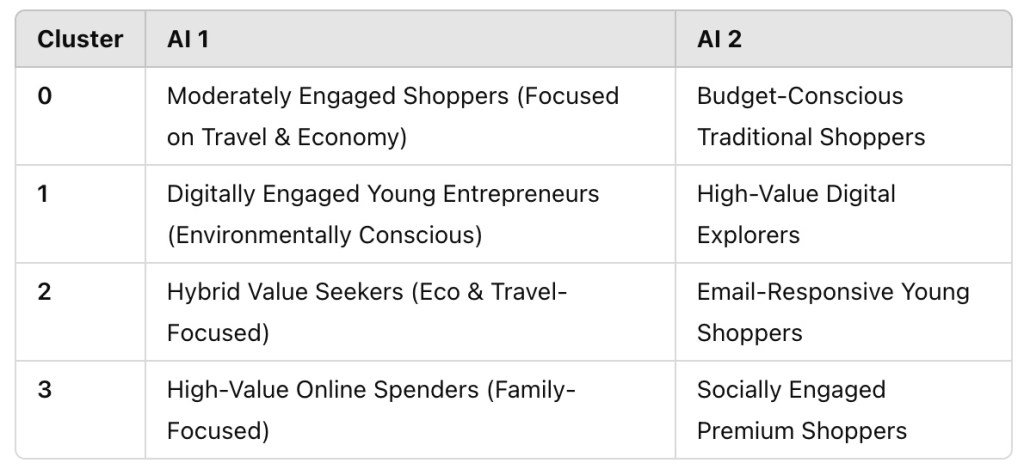
When analysing the results of both tools, we found that while the clusters showed certain similarities, there were also notable differences in how each AI grouped consumers. One tool segmented users based on factors such as digital engagement and economic focus, while the other prioritised purchasing patterns and marketing preferences.
However, beyond choosing the tool, the most important factor is for the company to define which factors are truly key to its business. Not all segmentations provide the same value for every strategy, so it is essential to establish from the beginning which variables should be prioritised. E.g. Demographics for a brand awareness strategy. AI can discover new segments that were not previously considered, but human judgment determines which information is most relevant for strategic decision-making.
Comparison of Segments Identified by AI
Key Strategies by Segment
Defining an effective strategy for each consumer segment allows us to maximize message relevance and enhance audience connection. Adapting communication and marketing tactics according to the specific characteristics of each group ensures greater impact and better business results.
AI can also provide suggestions on how to approach each segment more effectively. For example, for Budget-Conscious Traditional Shoppers, it suggests creating messages focused on value-for-money and sustainability. For High-Value Digital Explorers, it recommends developing aspirational content, exclusive products, and premium digital experiences. However, it is human analysis that makes sense of these insights, enabling strategy adjustments with creativity and market knowledge.
Brand Narrative in the Data Era
While segmentation allows us to personalize strategies, a frequently underestimated element is brand narrative. Beyond data, consumers seek to identify with stories and values. Therefore, the challenge is to integrate data analysis with authentic and emotionally resonant communication, ensuring a lasting connection with the target audience.
To achieve this, it is essential to understand what the consumer feels and thinks, as this allows us to evaluate whether the brand is truly resonating with its audience. It is not enough to craft an attractive message; it must connect with the emotions, aspirations, and concerns of the audience. This way, brands can adjust their communication and strengthen their positioning, achieving a more genuine and meaningful relationship with consumers.
In a world driven by data and automation, a key question arises: Are we using segmentation merely to sell better, or are we truly building more human and meaningful relationships with our customers?

 Mind of Consumers